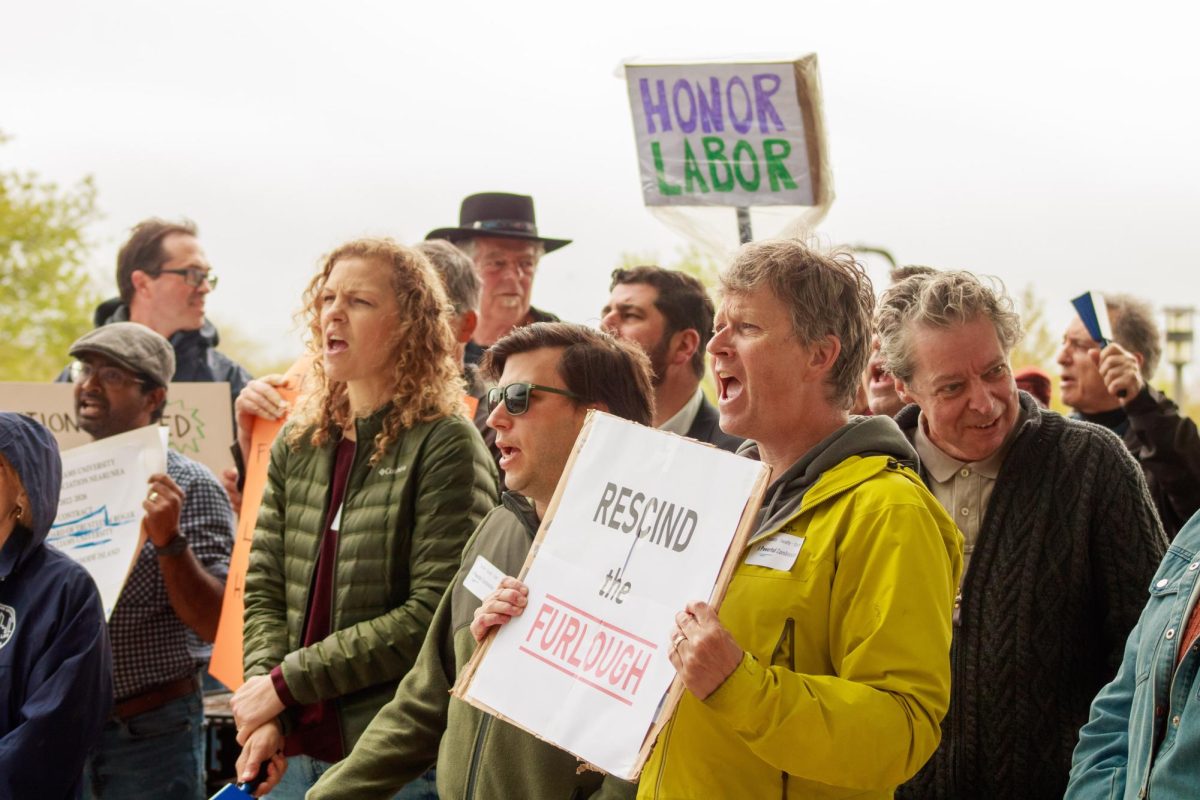
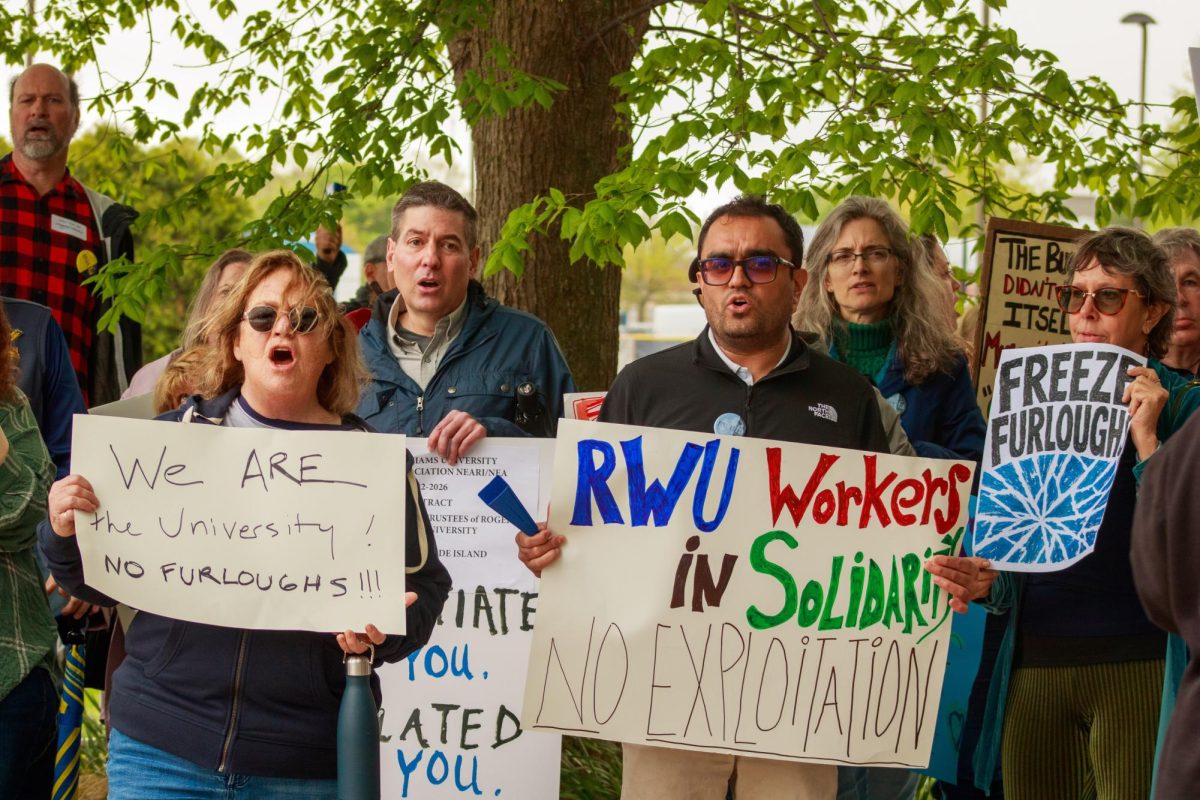
A megaphone cut through the cold outside Roger Williams University’s administration building on December 11th, as students pressed shoulder-to-shoulder along the sidewalk, protest signs lifted high in the air. In the crowd’s call-and-response, one chant was repeated in a steady loop: “No confidence, no furlough.”
The chant echoed what was happening inside the university’s governance system. Miaoulis called the faculty’s vote of no confidence against him “unfortunate,” saying it was “up to the board to react,” and describing his role as reporting to trustees who set annual performance goals. Asked whether he believes he has met those goals, Miaoulis answered: “Absolutely, yeah. There’s no question.”
Protesters declared the furlough plan as more than a budget fix—calling it a wage cut that would land hardest on the workers students say they rely on every day. This protest was a culmination of all the distress caused since the furlough announcement, and would soon devolve into a direct, face-to-face argument with the president.
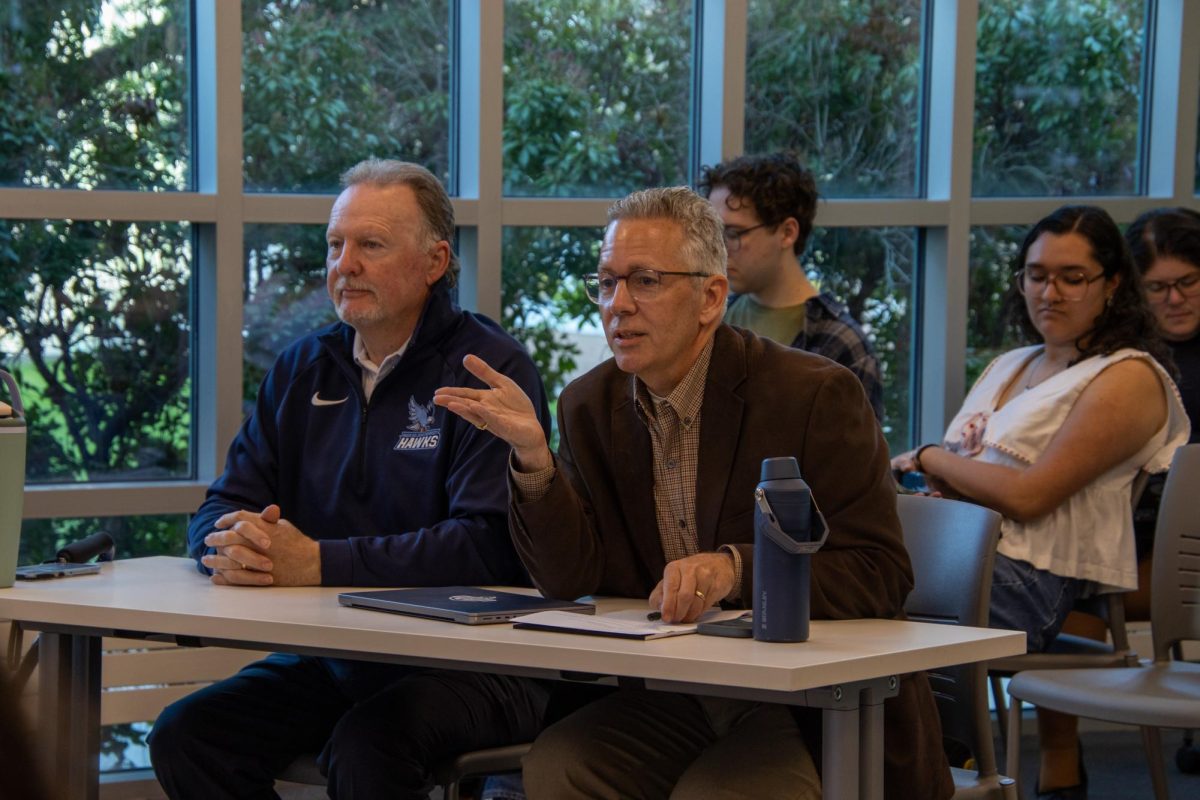
The demonstration happened the day after Ioannis Miaoulis sat down for an interview with The Hawks’ Herald—an interview where he dismissed a student trust survey as statistically meaningless, argued the furlough was a “management decision,” and claimed some students had been “worked up by the faculty.”
By the next afternoon, students were answering back in public, outside his building, with their own microphones.
A new semester, an unfinished conflict
The protest capped a tense end-of-semester stretch in which the furlough plan caused a rolling backlash: union outrage, student anger, and scrutiny of how the university explains its finances.
In earlier reporting, the furlough was framed by the administration as a one-week unpaid requirement designed to close “up to half” of a budget gap without relying on what the president described as “supplemental endowment draws.” Union leaders and faculty members argued the rollout represented a breakdown of trust and governance, not just a cost-saving maneuver.
Now, as the new semester begins, the central question hasn’t changed much: is the furlough an unavoidable solution—or a choice shaped by priorities students no longer accept?
“It’s not hitting us equally”
One of the protest’s clearest themes was equity—who loses what, and who can afford the loss.
A student speaker argued the furlough may be structured as “equal” on paper but not in real life, pointing to lower-paid campus workers as the people most likely to feel a week’s pay as rent, groceries, or utility shutoff money.
“It’s not hitting us equally,” the speaker said. “60% of Americans live paycheck to paycheck… that 60% works here. They unplug our toilets. Clean our sinks… I don’t see the president ever.” The speaker asked how many workers would have to “squeeze pennies” because leadership “doesn’t want to take a pay cost.”
Speakers also pushed back against what they described as the administration’s expectation that students remain polite and quiet even when they feel ignored. “We are allowed to be angry and passionate about our school. We are allowed to have feelings about it,” one speaker said as the crowd cheered.
That framing—daily labor versus administration’s distant authority—set the emotional logic of the rally. Protesters repeatedly framed facilities, dining, and other front-line staff as the people who keep campus functioning, and they treated the furlough as a direct blow to the workers students depend on.
The interview: “I did not get a 70% raise.”
In the interview the day before the protest, Miaoulis was asked about one of the biggest flashpoints driving student anger: executive compensation.
In earlier reporting, the university’s publicly available Form 990 filings show the president’s reportable compensation increased from $604,342 (2022) to $1,026,266 (2023)—a jump many students have scrutinized.
Miaoulis disputed the idea that he received a dramatic raise in the way critics describe, saying the picture is “complicated” and tied to how compensation is reported across fiscal and calendar timing. He emphasized that he does not set his own salary and pointed responsibility toward the board.
“Yeah, no, I did not get a 70% raise,” he said in the interview. “That’s the bottom line.”
That line—intended as a correction—did not stop the underlying problem: students and faculty see the increase “on paper,” and they are responding to what the numbers communicate about power and sacrifice.
A Survey, Disregarded
Another spark for the protest came from a student-created survey that has circulated widely as evidence of collapsing trust in upper administration.
At the rally, a student organizer told the crowd she created the survey because she did not believe the administration had actually asked students how they felt. She read results aloud, including:
At the rally, a student organizer told the crowd she created the survey because she did not believe the administration had actually asked students how they felt. She read results aloud, including: 75% of respondents said they do not feel upper administration cares about student opinions and feedback; 72% said they do not trust university officials to make good decisions on students’ behalf; and 52% said they had considered transferring because of the school’s lack of care.
But in the interview the day before, Miaoulis dismissed the survey’s credibility, focusing on sample size and motive.
He called it “filled out by 98 students out of 4,000,” and said you “cannot draw conclusions out of 98 students out of 4000.” He added he didn’t know how the survey was written or the “motivation” behind it.
“A management decision”
In the interview, Miaoulis described the furlough not as a negotiable policy but as a structural authority decision.
“The unions… are considered labor. And imposing a furlough is a management decision,” he said. “Not a labor decision.”
He argued that union notification follows contract rules and that the administration followed those rules. He also emphasized that the university had considered multiple budget options before settling on the furlough approach.
That framing helps explain why the protest took the shape it did. Students weren’t only arguing against the furlough’s impact—they were arguing against the idea that a decision this consequential can be treated as management’s unilateral decision without meaningful campus consideration.
The protest turns into a confrontation
As the rally continued, students moved from speeches to questions when the president himself made a surprise appearance at the demonstration.

One student speaker raised accessibility concerns, describing being told repairs were difficult because of cost and contrasting that with leadership’s apparent comfort. The speaker referenced seeing an administrator leave in a Mercedes-Benz and framed it as a clear moral contradiction: money is “tight” when students ask for access, but somehow not tight when leadership lives well.
The exchange then landed on the question that became the protest’s main refrain: “Why don’t you take a month long furlough?” someone asked. “That would [help] a lot better.”
Miaoulis responded by arguing the university’s first priority was to avoid harming students and the second was to distribute burden “equitably” across the university—not “only one part” carrying the cost. He described the furlough as “the only solution we found,” saying it would be less than a 2% reduction in salary.
A student pushed back immediately: “But you didn’t answer the question.” Another student framed it as a lived reality problem, not a percentage problem: people “live paycheck to paycheck.” A week without pay, they argued, is a fundamentally different sacrifice depending on income.
Miaoulis said he had taken a pay cut and would be “taking the same furlough as everybody else.” The reply that followed captured the heart of the protest: “Your furlough is not equal to that of an employee living paycheck to paycheck.”
Miaoulis acknowledged the distinction but defended the structure: “Proportionally, it’s equal, then the impact may not be equal,” he said, adding that the university was in discussions with lower-paid unions about how to make it easier.
The crowd’s anger occasionally veered into personal heckling. At one point, a shouted jab referenced a supposed drinking problem, highlighting how quickly the furlough debate has expanded into broader distrust and personal grievance.
“I don’t want to see you, drinking at the Lobster Pot every Sunday night!” one student yelled. Another proclaimed “The alcohol got to him!”
As the President departed from the rally, he went back to his car and brought out the campus dog Roger, which quickly had protesters break into a “Free Roger” chant, briefly interrupting the regular speeches.
The interview’s most combustible claim
The day before the protest, Miaoulis suggested the student backlash had been amplified by faculty influence.
“Some of the students have been worked up by the faculty and that’s what has caused this. This problem,” he said, adding that he wished students had more accurate information.
The protest itself complicates that claim. Speakers repeatedly grounded their anger in lived experience—wages, working conditions, accessibility, and the feeling that students are expected to be quiet while decisions are made for them.
How organizers built the protest fast
In a post-protest conversation, Henry Siravo, Vice President of Student Senate and a leading organizer of the event, described the rally as a quick-build effort shaped by urgency and fear—specifically, the fear that silence would be used as evidence of apathy.

“My biggest fear is that no one was going to show up and it would be pretext for the university to say students don’t care,” Henry said.
The organizer described an internal sprint: launching an Instagram account, @rwustudents4change, to reach students, building a group chat, and pulling people together under short notice. The turnout, they said, included students they had never met—evidence, to organizers, that anger about the furlough wasn’t limited to one club or one friend group.
Where the story goes now
Heading into the new semester, the conflict remains unresolved in a way that’s bigger than whether the furlough saves the number it’s designed to save.
The administration’s position—outlined in the interview and defended outside admin—is that the furlough is a temporary bridge, built for equitable burden-sharing, and justified by the urgency of closing a budget gap with minimal student impact.
The protesters’ position—delivered through speeches, survey numbers, and direct confrontation—is that the furlough is a moral failure of the administration, one that reveals how power operates on campus when the people most affected are asked to absorb the cost.