Is a Lionfish Invasion Coming to Rhode Island?
What do lionfish have to do with Rhode Island? Right now, not much but that could change. Lionfish are an invasive, nonnative species originally from the Indian and Pacific Oceans, and they’ve already spread throughout the Western Atlantic, the Caribbean, and the Gulf of Mexico. As ocean temperatures continue to warm due to effects of climate change, it could become possible for their range to expand northward, potentially making them a future threat to New England’s waters.
What’s the big deal about Lionfish?
Invasive species are extremely destructive and can cause irreversible damage to the balance within ecosystems. In addition to harming the environment, invasive species also have significant economic cost. According to Frazer, In 2001, invasive species were estimated to cost over $1.4 trillion each year due to the damage they caused and financial burden of their removal. In their unnatural environments, invasives species cause harm through habitat alterations, predation, and resource competition. Because they are not natural to their new environment, they often lack predators which allows them to have unchecked control in their new area. Marine invasions are not as easily detected as terrestrial ones, which can lead to greater environmental harm. There are factors particular to Lionfish that make them especially problematic. They prey on reef fish and crustaceans up to the size of their own bodies, they reproduce rapidly, and can survive long periods with no food intake, according to Johnston. Native threatened and endangered species are often targeted by these foreign invaders and their loss reduces biodiversity. Lionfish are very successful ambush predators and can defend themselves with their venomous fin spines. Within it’s range, lionfish are virtually undetectable by potential prey species, who fail to respond to their scent or visual presentation, according to Lonnstedt.
How did they get here?
Through genetic analysis, it is believed that lionfish were introduced from a single site in Florida in the 1980s and have spread quickly thorough ocean currents and larval dispersal, according to Green. Once lionfish became an established species in the Bahamas, hurricane action quickly spread them throughout the island chain. A study conducted by Johnston found that due to storm altered water flow, lionfish saw a 45% increase in dispersal. Lionfish have now spread significantly throughout the western Atlantic Ocean, Caribbean Sea, the Gulf of Mexico, and many more places.
Why are they an issue?
The presence of lionfish has caused many direct and indirect negative impacts due to their predation. Lionfish are generalist predators and will eat up to 4% of their body weight. This appetite has led to a reduction in native fish populations, according to Frazer. The same researchers conducted a study in the Bahamas found that lionfish on a sample ecosystem of reef reduced recruitment of native reef fishes by 79%. Coral loss due to unrestricted algae growth is one example of an indirect impact of lionfish predation. When lionfish prey on herbivores such as parrotfish, surgeonfish and damselfish, algal grazing is reduced, and the algae is able to take over and outcompete corals. Lionfish have settled in seagrass beds and mangroves, putting juvenile reef fish at risk. Lionfish in Mangroves in the Bahamas have been in direct competition with juvenile grouper species due to their generalist appetite, according to Johnston. A study conducted by Harris found that higher lionfish densities have been found on artificial reefs in comparison to natural reefs, although this could be due to a higher proportion of lionfish being missed on natural reefs.
What can we do?
We can eat them! Despite having 18 venomous spines, the fish is safe to eat and tastes similar to other whitefish. In 2012, The National Oceanic and Atmospheric Administration (NOAA) created a campaign that promoted the consumption of lionfish as seafood, called “Eat Lionfish.” This campaign showed that people were more likely to pay to eat lionfish when they knew it would provide public benefit. A study conducted by Huth in 2018 on marketing lionfish meat showed that customers were willing to spend 26.4% more on lionfish meat after they were told that consumption management can help prevent local fish extinctions. The tourism industry has also been very helpful in lionfish mitigation. Tourists will pay to go on lionfish expeditions where they are able to spear their own lionfish. There are also such things as lionfish derbies where people compete for a cash prize to see how many lionfish they can spear.
At this time, it is very unlikely that it is possible to fully remove lionfish from the areas that they have invaded. While placing an economic value on lionfish removal through commercial lionfish fisheries can seem like a good mitigation strategy, it risks incentivizing maintaining lionfish populations. Targeted removal efforts are extremely costly and further data collection must be done in order to come up with a successful mitigation plan.
My experience with Lionfish
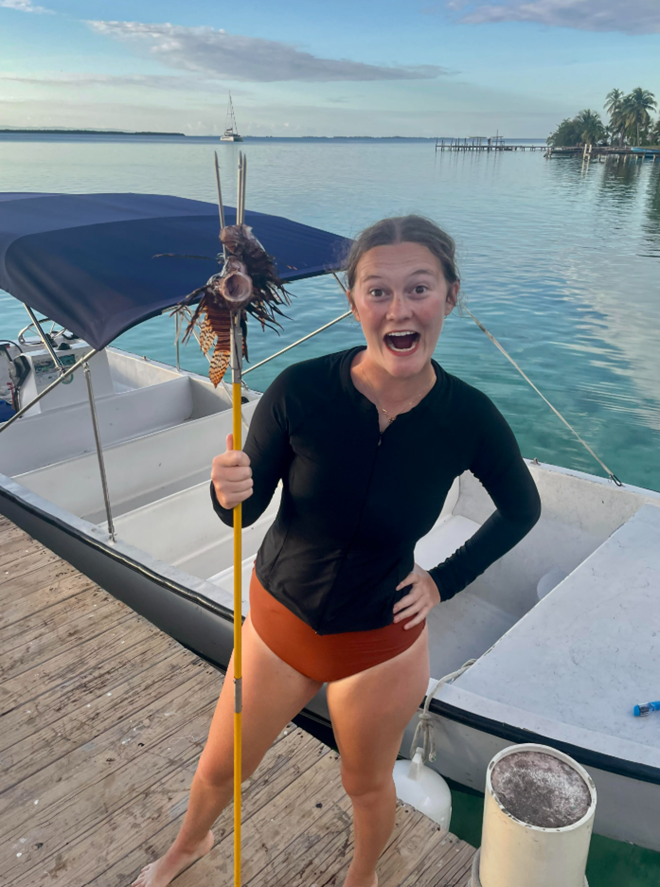
I was fortunate enough to study abroad last winter intersession in Belize and study tropical ecology. We went on many snorkeling expeditions where we saw a variety of native fish and other organisms. Our guide would carry a sling spear with him in case we saw any lionfish. It was so cool to see him so effortlessly spear the invasive predator and I knew I wanted to give it a try! Thankfully our guide taught me how to use the spear, and we saw another lionfish. After I speared the fish, our guide told us that he was going to take it home and cook it for dinner! I was so lucky to have been given the opportunity to spear a lionfish and do my part in protecting the marine habitat.