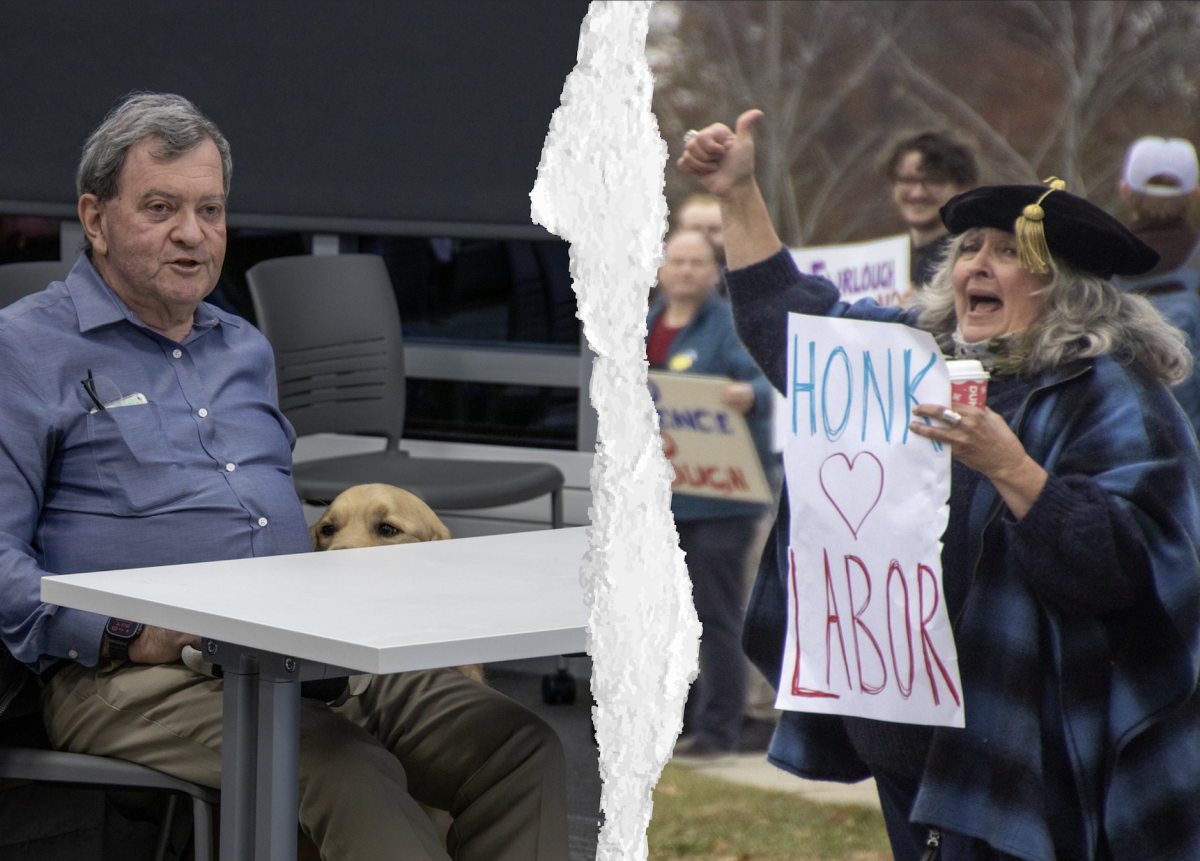
I am writing in response to the February 10 article by Ryan Robertson regarding the student protests over the Administration’s plan to furlough faculty and staff as well as the coverage on The Scoop of the March 2nd Student Senate meeting with the president. I think I can speak on behalf of my faculty and staff colleagues that our student’s attention on this issue is very much appreciated and buoys our morale. I noticed on the coverage, several of my own students in attendance at the Senate meeting – and no, they were not “worked up” by me – I have never mentioned the issue in a class. They are the engaged and civic-minded students I know them to be. I found the president’s responses both in the interview and Senate meeting to be dismissive of the views of our students who brought forth very legitimate concerns and deserved better answers to their questions.
As you can imagine, the planned furlough has caused a considerable amount of duress among faculty and staff, many of whom live paycheck to paycheck. Students have been right to point out the inequities of this plan, which will most certainly be harder for some than others.
When the president said, “If you are union, you are labor and you can’t be involved in management decisions”, that is a statement that is counter to the spirit in our contract – agreed to by both “management” and “labor”. We are meant to be consulted and work together to find solutions in matters of wages – something we did during COVID. There were financial challenges at that time, the president came to the unions to seek a solution. A plan was agreed upon to reduce our salaries and then voted on by the faculty. We did this twice and postponed contact negotiations by a year, further dampening our salaries in what was a shared sacrifice during unprecedented times.
I have never been referred to as “labor” in my many years as a teaching professional having worked under 7 presidents. But if labor is developing and teaching the best courses I can offer, investing my energy and time in my students and their growth, then I will wear that mantle proudly. As faculty laborers, we build curriculum, manage departments, involve students in research, mentor faculty, look after our classrooms and equipment. We invest hours in organizing exhibitions, events and performances. We give our weekends to Open Houses, Summer days to orientation, we meet with families and counsel students facing the many pressures of higher education. We do the unseen work in countless committees that move the business of this university forward. But know this: In labor there is solidarity, shared purpose and there is strength in our union.
While technically, a management decision has been made, it does not mean that it was a good one. Quite the opposite. Other solutions were available, should management had chosen to engage with the unions to find a path less painful. Instead, the repercussions of this decision are a loss of trust, real harm and hardship to the hardworking people who provide the product and services of this university, and poisoned waters at a time when we should be navigating a new contract together and planning for the future.
In a famous quote, Rear Admiral Grace Murray Hopper said, “You manage things; you lead people.” A leader in this situation, would have been more forthcoming, more transparent about the financial situation that the university is in. Instead, we have had shifting narratives. A 2-million-dollar deficit in August grew to 3.5 million by November, when furloughs were announced – a number we can’t verify as there has been no transparency.
A leader, who has seen a steady drop in enrollment every year since his arrival, would take some of the responsibility for this decline. While we are indeed in a demographic trough, not all universities have seen the dip in enrollment that RWU has. The decisions by management to eliminate programs, reduce some to minor-only programs while investing in others, clearly has not yielded increased student interest. Management makes marketing decisions, oversees recruitment, prioritizes facilities investments and leads development efforts. These managerial decisions are partly to blame for our predicament, and a leader would accept that responsibility.
A leader would articulate the problem, work with all affected parties, and build consensus for a path forward. Not everyone would be happy in the end but with transparency and dialogue we could respect a decision knowing we were part of the process. Obviously, none of that has happened.
A leader would not have been so dismissive of the views of the students. While a small, survey sample size, to be fair, shows discontent, those voices and viewpoints matter, need to be heard and acknowledged. All too often in politics and life are the views of young people dismissed. We should expect more from those in higher education who are in a position to lift those voices up and at the very least, engage in a respectful dialogue.
Students are witnessing a difficult moment for this university and should judge how its leaders are responding. In my view, we are seeing not only poor management, but an absence of the kind of leadership needed in this time. It is this reason that has caused the faculty to vote twice now, “no confidence” for this president. We all deserve better.