President Ioannis Miaoulis was asked a direct question at Student Senate on March 2nd: What would it take, in his view, for a university president to lose the legitimacy to lead—if a faculty vote of no confidence doesn’t meet that threshold?
He did not answer it.
Instead, he called faculty criticism “totally inappropriate,” dismissed a reference to a Bristol restaurant as “ridiculous,” and suggested that if everyone at the university had simply done their jobs, the furlough controversy wouldn’t exist.
The exchange became the defining moment of a Student Senate appearance that was supposed to give the president a chance to explain the university’s finances and reassure students heading into mediation with the faculty union. He came with a pitch: the furlough was a small, temporary sacrifice—less than 2% of salary—necessary to close a budget gap and demonstrate fiscal responsibility to the board of trustees. He left after telling a room full of students that the people who teach them aren’t doing their jobs right.
The President’s Case
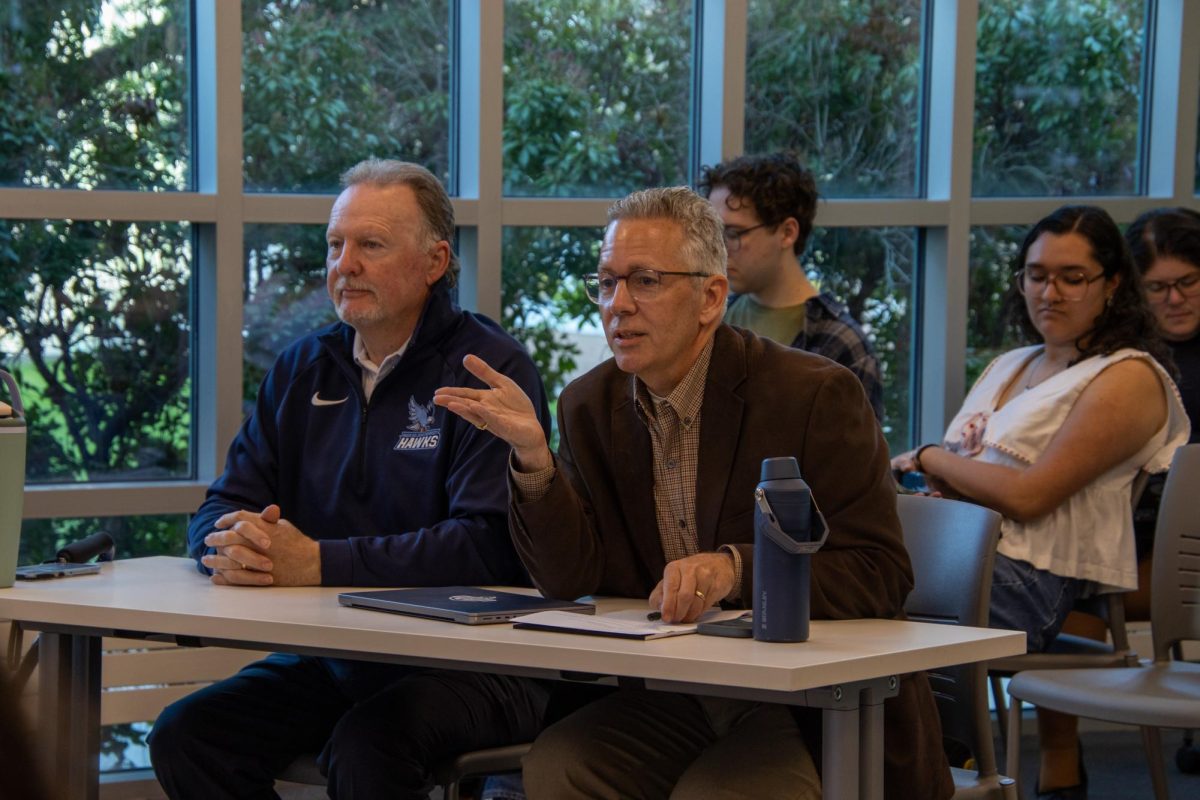
Before the speakers list opened, Miaoulis delivered a roughly twenty-minute overview of how the furlough came about. His framing was consistent with what the administration has said since November: RWU is a tuition-dependent institution facing a regional demographic decline, with 15% fewer students attending college in New England than a generation ago. Costs are largely fixed. Revenue is not.
“Whether you have 3,000 students or 4,000 students, you do have to clean the snow,” he said. “You do have to cut the grass, you do have to have facilities.”
He described a series of prior cost-cutting measures that fell disproportionately on non-unionized employees—withheld raises, reduced retirement benefits, mandatory vacations—and said none of it generated backlash because it hadn’t touched unionized workers. This year, he said, the administration decided it was time for everyone to share the burden.
“The reason that this went quietly is because they understood that this was the need for the university,” he said of the non-unionized staff.
He listed the alternatives the administration considered and rejected: further layoffs would damage operations; freezing raises would only affect non-union employees; cutting retirement benefits had already been done. The furlough, he said, was the only option that distributed sacrifice universally. He emphasized that every union member received a raise this year that exceeded the less-than-2% cut.
“So nobody is running out of money this year because of that overall,” he said.
He also offered his version of the timeline with the unions. He said the administration followed the contractual requirement to notify them a day before implementation, and that he offered to meet immediately after. The unions, he said, didn’t respond to scheduling requests. Instead, the state-level union’s lawyer sent a letter to the university’s legal counsel—CC’ing the governor—while he was still waiting for a meeting.
“This is while I was waiting to have a meeting with the unions,” he said. He described the eventual meeting as “pretty cordial” and said a mediation was scheduled for that week, with the board of trustees in “full alignment” with the furlough decision.
He closed with a summary that would echo throughout the evening: “These are the facts. This is what happened.”
The Question
The first name on the speakers list was this reporter’s.
The question drew on months of reporting and on what multiple professors had described in conversations this semester.
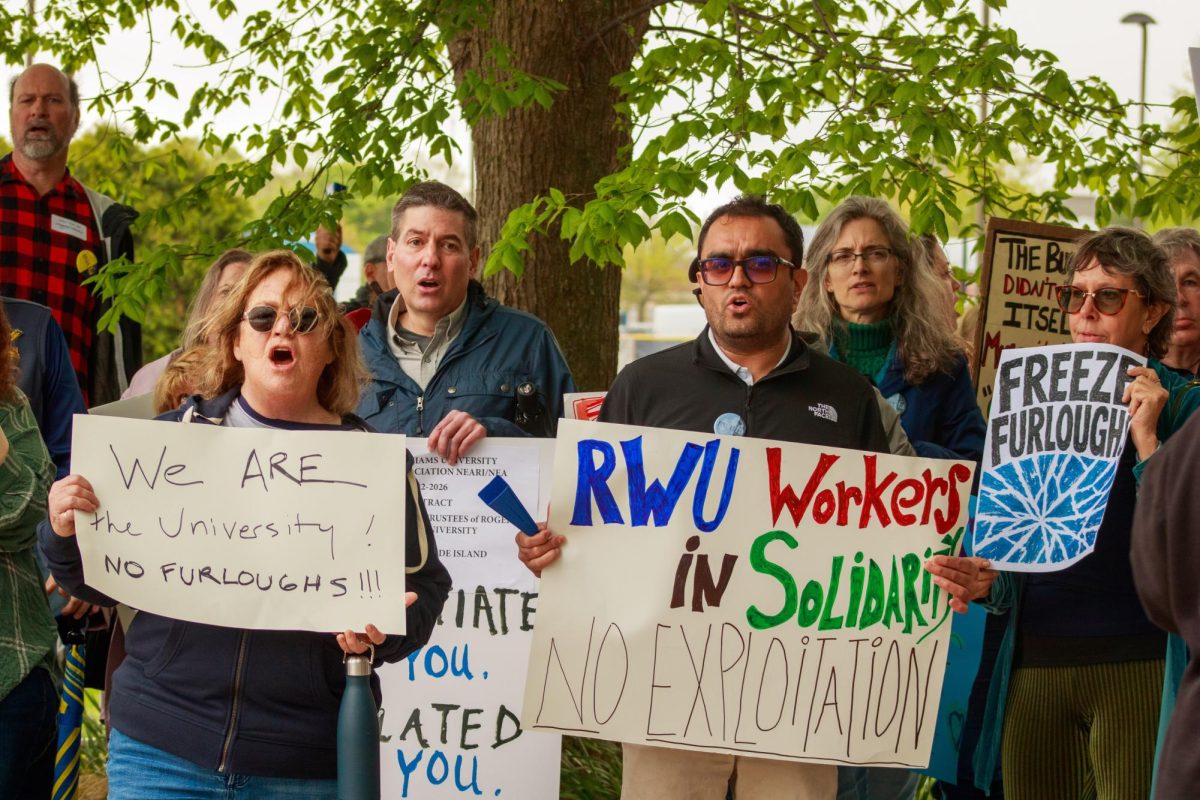
The question was this: “There’s been no question that since the furlough situation that your leadership has been called into question. I’ve had multiple professors express to me this semester that they feel as if you’ve disappeared, for students, your last contact with them, ended at the rally, where they asked questions such as, ‘why don’t you take a month long furlough,’ that ‘you are not living paycheck to paycheck’ like the other professors, that they ‘don’t want to see you drinking at the lobster pot.’ And of course, the most recent faculty vote of no confidence happened and the following Senate’s vote on that was 24 approved, 0 disapprove, and 1 abstain. So my question is, what would it take in your view for a president to lose legitimacy to lead if a faculty no confidence vote doesn’t meet that threshold?”

The Answer
What followed was the most revealing exchange of the evening—not because of what Miaoulis said about the furlough, but because of what he chose to talk about instead.
He began by criticizing the faculty for raising these issues with students at all.
“It’s inappropriate for faculty to use classroom time to replace teaching you what they’re supposed to teach you, to resolve their personal issues with the administration,” he said. “This is totally inappropriate.”
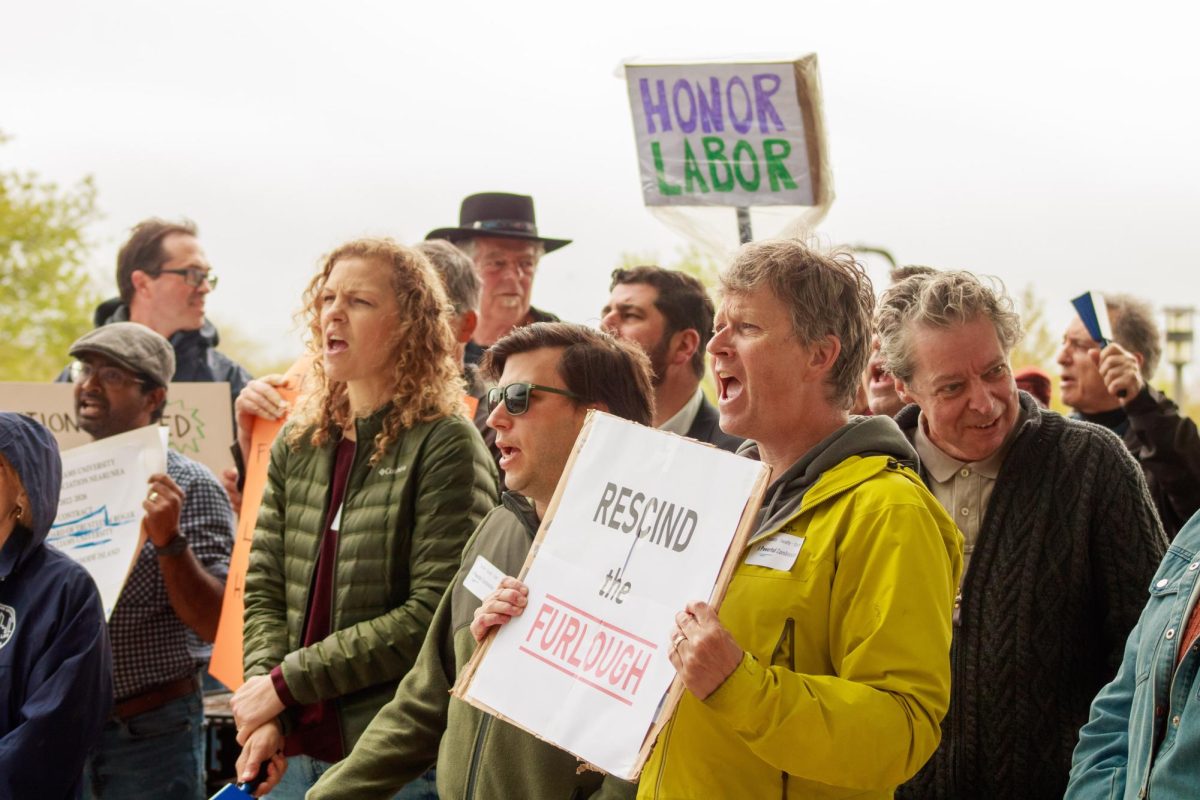
He then singled out the Lobster Pot comment—a remark originally made by a student at the December protest—as an example of what he considered baseless personal attacks.
“Some ridiculous things like the lobster pot,” he said. “I mean, what does that have to do with the furlough? You know, there are all these things that have accumulated, that to attack me personally, that are not based on facts, or critical thinking that the faculty is supposed to be teaching you.”
He then pivoted to a broader indictment.
“My job is to make sure the university would run smoothly,” he said. “It will ensure that you get a good education. The job of the faculty is to deliver that education. And if everybody did the job right, we wouldn’t be here now. But unfortunately, some people do their job right and people don’t.”
He then pivoted to attacking the reporter’s question: “If you have specific questions, maybe you did, but it was like 10 different things. You just ask me and I can try to answer specifically”
He returned to the Lobster Pot a second time, unprompted, as though the restaurant itself were the issue.
“I go to the lobster pot once a month, and what does that have to do with—which is one of my favorite hangouts, actually?” he said. “What does this have to do with the furlough? And I don’t get that piece.”
The question about legitimacy—about what threshold of lost confidence would cause a president to reconsider his position—went unanswered.

What Was Asked and What Was Answered
It is worth being precise about what happened in that exchange.
The question was about legitimacy. It cited a formal action—a vote of no confidence passed by the faculty—and asked the president to articulate what, if not that, would constitute a loss of legitimacy sufficient to warrant stepping aside.
The president’s response addressed none of that. He did not discuss the no-confidence vote. He did not explain what legitimacy means to him or where he believes it comes from. He did not say whether he thinks a president can lose the mandate to lead, or what that would look like. He did not acknowledge the Senate’s 24–0 endorsement of the no-confidence resolution.
Instead, he talked about the Lobster Pot.
He framed the entire controversy as a faculty-driven smear campaign, characterized the classroom as a venue being misused for personal grievances, and implied that the backlash was the product of people not doing their jobs—not a response to the way his administration has governed.
That framing has a specific implication: that students who are angry about the furlough are angry because faculty told them to be, not because they arrived at that conclusion on their own. Miaoulis made this argument explicitly in his December interview with The Hawks’ Herald, when he said some students had been “worked up by the faculty.” At Student Senate, he extended it: the faculty aren’t just influencing students—they’re doing it on the clock, in the classroom, instead of teaching.
It is a claim that treats student anger as a symptom of faculty misconduct rather than an independent judgment. And it was delivered to a room full of the students whose independence he was questioning.
The Rest of the Evening
Other students pressed on different aspects of the controversy, and the pattern of the president’s responses was consistent.
Another student asked what alternatives were considered before the furlough and why the unions weren’t consulted. Miaoulis repeated the management-decision framework. “If you are in union, you are labor,” he said. “And if you are labor, you cannot be engaged in management decisions.” He said consultation wasn’t required, and that the COVID-era precedent of working with unions was justified only because that crisis was “much more dramatic and severe.”
An anonymous question, read aloud by a senator, cited the Chronicle of Higher Education’s annual compensation report—which showed Miaoulis received $1,182,193 in total compensation in 2023, a 62% increase from the prior year. That figure included an $865,126 base salary, a $150,000 bonus, and $155,967 in nontaxable benefits. The data placed his pay-to-average-professor-salary ratio at 9 to 1.
In his earlier interview with The Hawks’ Herald, Miaoulis had said: “I did not get a 70% raise. That’s the bottom line.”
At Student Senate, confronted with the Chronicle’s 62% figure, he said the spike was a reporting artifact caused by his previous contract ending in 2023, which triggered a deferred compensation payout. He said two years of performance-based pay also landed in the same reporting window, inflating the total. He predicted the next year’s report would show a roughly 40% reduction for the same structural reasons.
“It was basically everything came in that year that you see the big spike,” he said.
He then turned the critique back on the room: “You just take one report from a newspaper, or you listen to some faculty member, you know, in your classrooms—you’re not supposed to talk about my compensation during your class time—and you build a theory around it.”
The explanation may be technically accurate. But it was the third time in the evening that Miaoulis responded to a factual question by criticizing the people who raised it.

What the Meeting Revealed
Miaoulis also took a question about the planned relocation of the Gabelli School of Business, which he framed as an enrollment-driven decision. He said 70% of RWU’s enrollment decline came from the business school and that the move was designed to give both business and humanities upgraded facilities. He denied that trustee Mario Gabelli influenced the timeline and said roughly $7 million had been raised in recent weeks. He acknowledged that some humanities faculty would lose their offices and their views. “I’m sorry about that,” he said. “But my job is to make sure the university will prosper in the future.”
But the business school question wasn’t what defined the evening. The defining moment was the one where the president was asked a question about his own legitimacy—a question grounded in a formal governance vote and months of escalating public conflict—and chose to answer it by talking about a restaurant.
When this reporter asked what it would take for a president to accept that he has lost the mandate to lead, Miaoulis responded by questioning whether the people who voted had been doing their jobs.
He may believe the Lobster Pot comment was irrelevant. He may be right. But it was not the question. The question was about legitimacy, and the president’s inability—or unwillingness—to engage with it was, for the students in the room, an answer of its own.