

If the President were any other employee, “the University would not hesitate to discipline and remove” someone “who failed so spectacularly in the job for why they were hired and claimed to have experience” wrote Jennifer Azevedo, Deputy Executive Director/Legal Counsel of the National Education Association of Rhode Island (NEARI) in response to the recent controversial furlough announcement.
Roger Williams University President Ioannis Miaoulis emailed faculty and staff on Nov. 13 to announce a university-wide plan requiring most employees to take one unpaid week where they don’t work. “Approximately $3.5 million in savings or improved revenue must be realized to close the year responsibly by June,” Miaoulis wrote in an email.
That furlough, Miaoulis wrote, would “address up to half of the projected budget gap” as RWU tries to reach a balanced budget without relying on “supplemental endowment draws”—a practice he described as unsustainable.
But faculty union leaders say the announcement and its timing reflect a deeper breakdown in trust and governance—one they describe as now “completely broken.”
The Announcement: A One-Week Unpaid Furlough To Cover “Up to Half” the Gap
In his furlough email, Miaoulis framed the decision as the “difficult” but necessary next step after earlier cost-cutting to close a deficit RWU “began the year” with.
He wrote the university had made “significant progress toward a necessary balanced budget,” but still needed roughly $3.5 million in savings or revenue before June 30. The furlough, he said, would help close that gap while preserving jobs and protecting operating budgets.
Miaoulis also emphasized that his Cabinet—and he himself—would participate, and that senior leadership would forgo participation in the fiscal year’s wage pool.
Administration later clarified additional details in a response to the NEEARI describing the furlough as “intended to preserve jobs” and address a “small FY26 budget shortfall.” According to that response, employees were asked to select a workweek—proposed during winter, spring break, or the week after graduation—“in order to enable affected employees to plan and without adversely impacting the student experience.” The same response document states that “most employees” would participate except Public Safety, Dining, and shuttle drivers.
Still, faculty leaders argue the question isn’t only what leadership decided—it’s how, and whether employees represented by unions should have been engaged before the decision became public.
Pickets and Protests

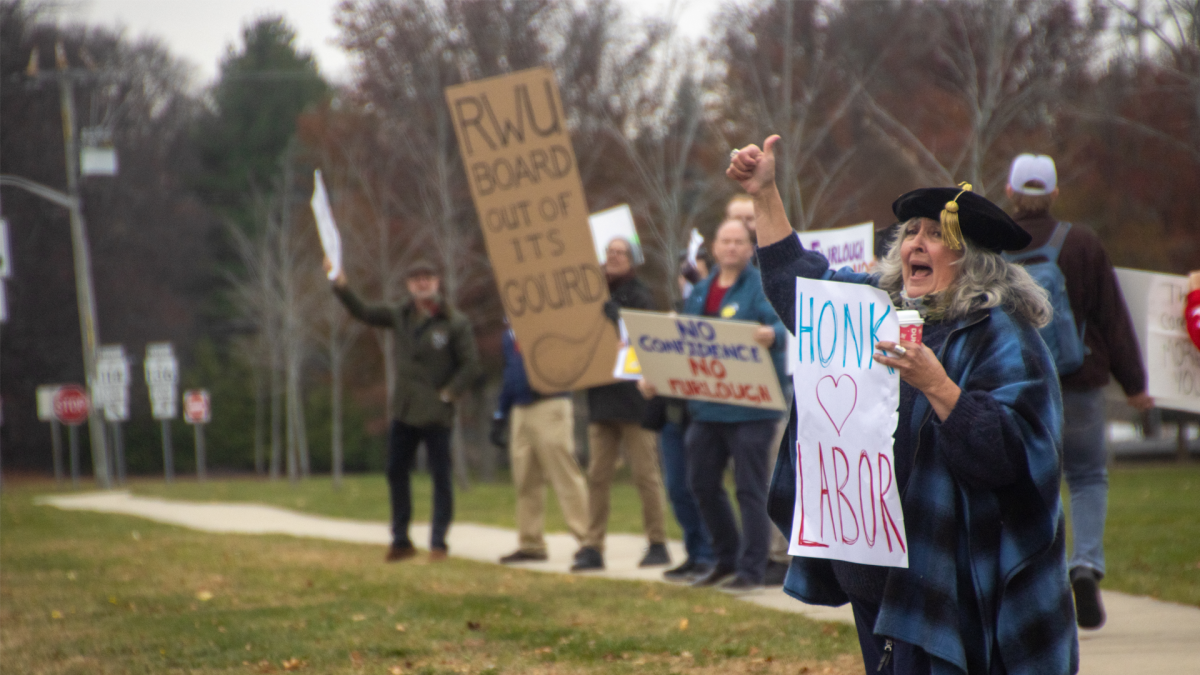
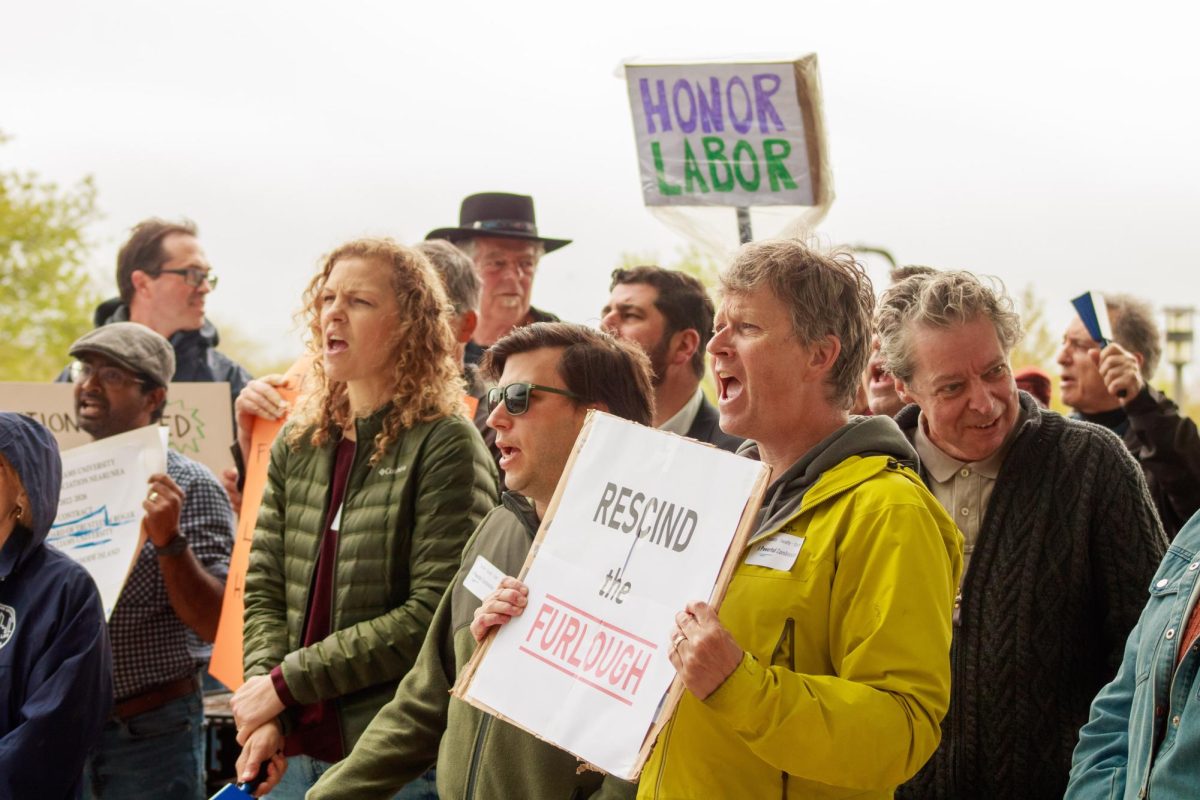
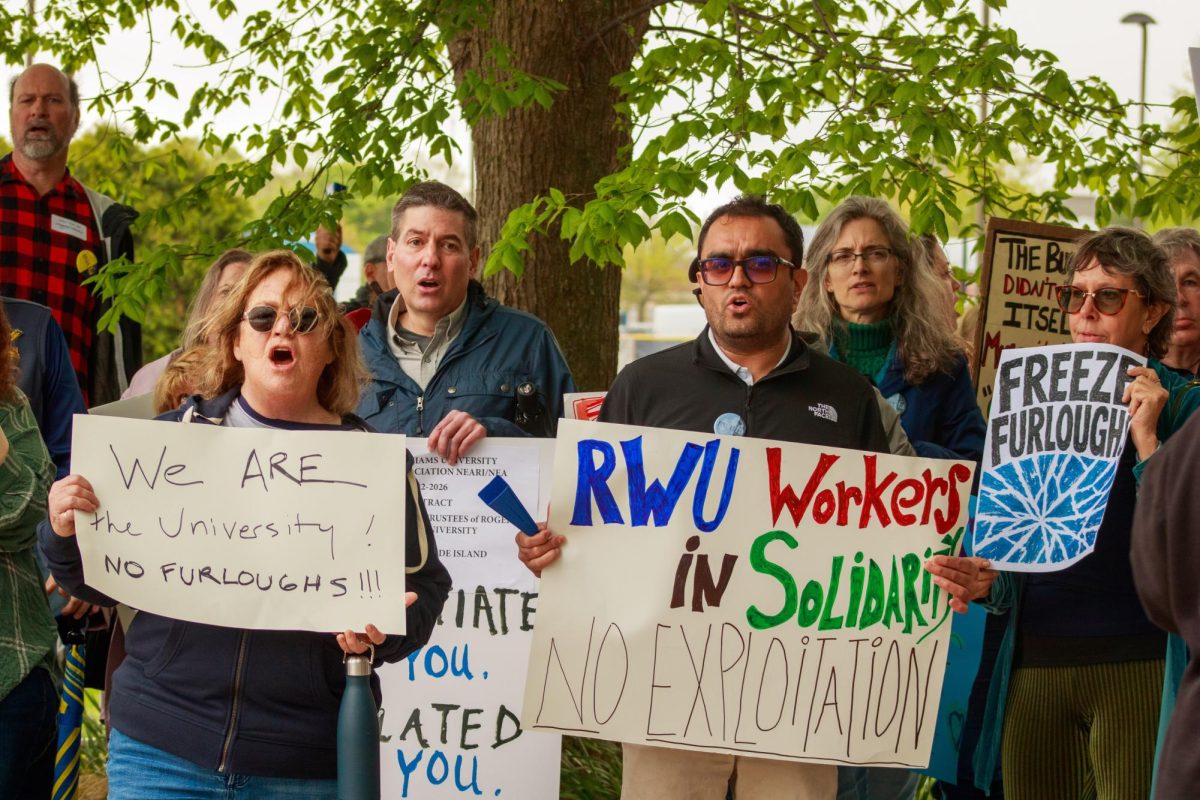
As the furlough plan spread, labor backlash arrived fast. Faculty and union members began organizing protests and pickets, criticizing the administration for announcing furloughs before fully engaging unions that represent employees. Faculty and students showed up on Nov. 21, from 9:00 a.m. to 4:00 p.m. near the RIPTA bus stop brandishing signs to protest the furlough. Protesters said they were there to make visible what they called an “invisible pay cut.”
The signs reflected the mood of the controversy: “STOP WAGE THEFT,” “NO CONFIDENCE NO FURLOUGH,” and “RWU BOARD OUT OF ITS GOURD” to name a few. Students joined intermittently between classes, some holding their own handmade posters, others simply standing beside in solidarity.
Faculty Union President Says Process and Trust Have Collapsed
Dr. Murphy, president of the RWUFA union, said most members learned about the furlough plan the same way the rest of staff did: through a campus-wide email from the president. He said there was a brief “courtesy call” to NEARI the day before the announcement but characterized it as a notification—not a discussion—about a decision that had already been made.
From the union’s perspective, Murphy said the rollout represented a departure from how major employee-impacting decisions have been handled in the past, because there was no meaningful consultation with union leadership before the announcement.
Murphy also raised concerns about how the furlough intersects under the collective bargaining agreement. He said that the collective bargaining agreements set basic terms like conditions of work and pay and noted that contracts often include processes to follow during a genuine financial emergency—such as retrenchment, which can involve program cuts or layoffs, but typically comes with specific requirements. Murphy argued those provisions do not necessarily apply here, adding that he does not believe the faculty contract includes language authorizing a furlough in the way it is being proposed.
Murphy contrasted the current approach with the university’s response during COVID-19 He said that in 2020, when the university faced what he described as an approximately $11 million shortfall, the administration presented multiple options, including a salary giveback that was negotiated with the faculty union. Murphy said the union proposed a scaled giveback structure which the administration later used as a model more broadly. He also noted that process included greater financial transparency, a sharp contrast to now as the administration is reportedly outright refusing to show unions the books.
Murphy said the furlough announcement landed inside what he described as a long-running breakdown in trust between faculty leadership and the administration. In the interview, he characterized the relationship as “increasingly adversarial,” adding that it often feels “punitive.”
In his view, the erosion of trust has reached a point where he is skeptical it can be repaired under the current leadership structure, saying the administration’s silence and limited financial transparency leads him to believe he doesn’t not know whether “the President… can repair” the relationship, or whether “the board is interested in repairing it.”
Student Senate Meeting: “We have to attack that budget”

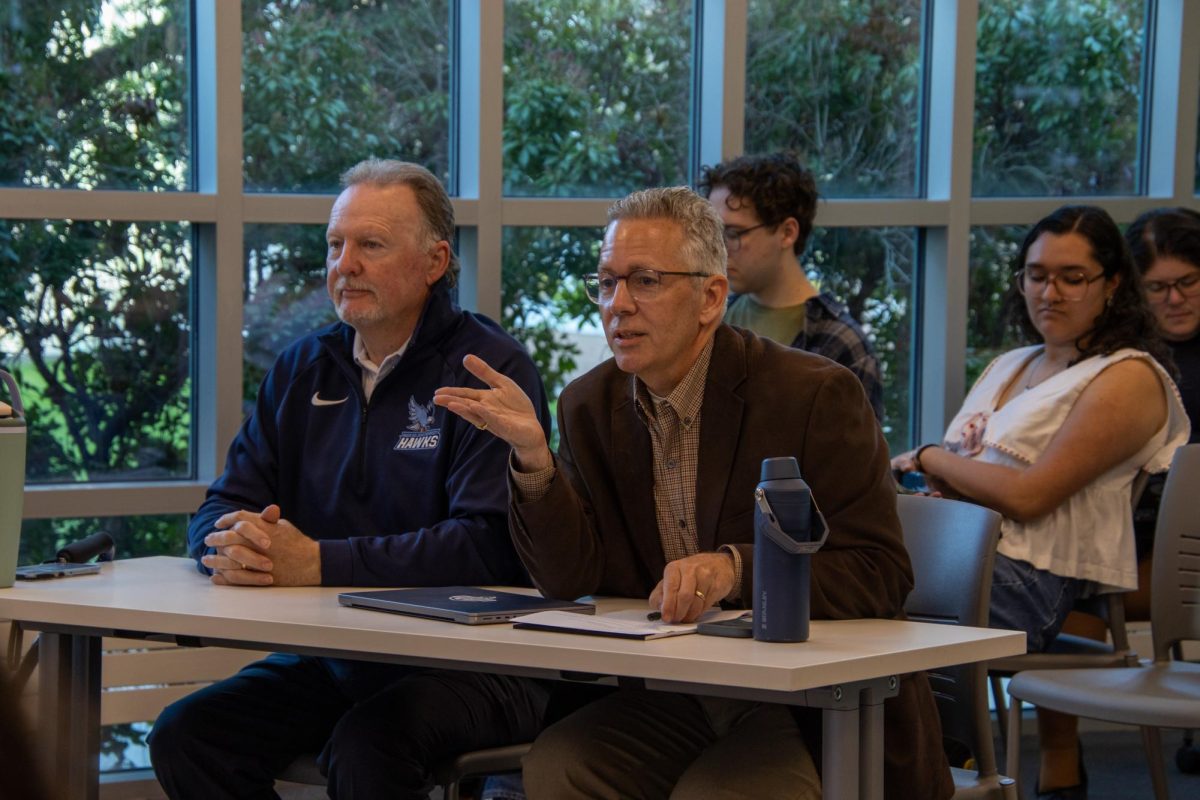
In the days after the announcement, the controversy spilled into student government—where John King, Vice President for Student Life, faced extended questioning on what students called a pattern of year-over-year financial instability.
During the meeting, King framed the situation as manageable in proportion to RWU’s overall operating scale, stating the university has a “$185 million operating budget” and is dealing with “a $3 million deficit”—which he characterized as “1.75%” He also referenced a larger gap from earlier, saying the university “started with a bigger deficit… in the 8 to $10 million range” and has been narrowing it.
At multiple points, King acknowledged the decision was controversial but emphasized urgency. “we knew this was gonna be an unpopular decision,” he said, but “We have to attack that budget.”
When asked whether leadership would reconsider the decision, King’s stance was consistently resistant to reopening it, when faced with more equitable alternatives he pointed back to the finality of the choice: “They’ve already made the decision.”
Student Senate Becomes Heated

Student Senate drew a full crowd. One exchange turned into the night’s biggest indictment: a student challenged King on the optics and ethics of the furlough beside the president’s pay, arguing they didn’t see how an administration could ask professors to forgo wages while paying a president over $1 million.
Student Senate’s Clubs and Organizations Chair, Henry Siravo, confronted King about protest retaliation and the climate of fear around speaking out. “Should we be concerned about retribution” for protesting? He asked, King said “absolutely not.”
And the no-confidence thread surfaced explicitly, Joshua Geaughan, a Capsized Tribune reporter, asked how King views Miaoulis’s presidency in light of the vote of no confidence against him, and whether the administration understands what that vote signals about trust and legitimacy. But King repeatedly stressed that he could not speak for the president directly.
Another student told King that even if the university says it doesn’t want students affected, “it is going to affect students,” arguing that if professors are unpaid during crucial weeks, they should not be expected to respond to emails or do grading work.
But the question reflected a broader anxiety that ran throughout the meeting: when finances and labor collide, students tend to get crushed in the gears.
A Student Survey Read Aloud — And a Campus Trust Problem

After King’s questioning, Laney Reardon, a junior, read results from a student opinion survey she conducted and distributed. She told the room the survey collected 97 responses and then delivered numbers that were emotionally explosive.
Among the highlighted findings, 72% of participants say they don’t feel as though the upper officials of the school care about their opinions and feedback. 71% of participants don’t trust the officials at the school to make good decisions on their behalf. And 93.8% of participants do feel that some or most professors care about student success
Even read quickly, the pattern is hard to miss: student confidence is significantly higher for professors than for administration—and a whopping half of the students surveyed admitted they’ve at least thought about leaving RWU. Reardon’s framing was not subtle: she said the reason she shared the results was that the general feeling from surveyed students was “distrust, hurt, and lack of hope.”
The survey’s written responses were even harsher.
One student wrote: “The University officials do not ask students for their opinions…they refuse to invest in their customers (students) or the best thing they offer (professors).”
Other students said, “The school operates like a pyramid scheme,” another outright said “Don’t come here, once you’re here… the board and higher staff only care that you pay tuition…” And another student wrote, in reference to Miaoulis, that “He is more concerned with getting his paycheck than the students and staff on this campus.”
That matters because the furlough decision, while formally about labor and budgets, is being experienced by students as question about what kind of institution RWU intends to be: a community anchored by relationships, or a business that treats relationships as a commodity.
The 990s: The Stark Increase on Paper
Fueling a part of the outrage is a simple comparison: presidential compensation now vs. then. In RWU’s 2023 Form 990, President Miaoulis is listed with $1,026,266 in reportable compensation from the organization.
In 2022, that figure was $604,342—a jump that aligns with the union’s claim of a dramatic increase year-to year. By contrast, in RWU’s 2014 Form 990, then-president Donald J. Farish is listed at $401,095 in reportable compensation. That’s the “stark increase” students keep circling.
The NEARI Letter: “Wage Theft”
On Nov. 24, Jennifer Azevedo, Deputy Executive Director/Legal Counsel of NEARI, sent a letter condemning the furlough plan and disputing its legality and ethics to the RWU Legal Counsel.
At its core, the letter argues that the “Action taken by the University squarely prohibited by federal labor law,” and that administration is “callously… pick[ing] their pockets” and frames the furlough as “wage theft.”
The letter also attacks leadership credibility, pointing to the president’s compensation and alleging that Miaoulis received a roughly 70% raise between 2022 and 2023 while employees face unpaid time.
They’ve also advised for all members to not agree to any furlough dates at this time, and that each unit will be filing a grievance report due to the furlough being in violation to the collective bargaining agreement.
Near the end, the letter states bargaining units will not be his lottery ticket to close the fiscal mess he and his staff have created,” a double entendre in reference to the Mega Millions lottery Miaoulis won last year. The letter concludes in a direct address to the President himself advising him “to reconsider this unlawful, and what is certain to be, devastating strategy.”
Shortly after, Jill Pais, Assistant Vice President of Communications and Media Relations, sent out a direct response to the letter. Most of it reiterates what the furlough entails but fights back on some of NEARI’s claims stating there was “direct communication” and that despite a prompt response to meeting requests from the unions, “the relevant unions have not responded to scheduling requests.”
Whether the furlough ultimately closes the gap or simply buys time, the fallout has already defined the real crisis RWU is facing: confidence. Between union leaders describing a relationship that has become punitive, students publicly questioning the ethics of administration, and the NEARI accusing the administration of wage theft, the university is now arguing for more than a balanced ledger, but instead legitimacy. If RWU’s leadership wants this to be remembered as a temporary measure rather than the moment the campus stopped believing its own administration, the administration’s next few weeks will matter as much as the next budget.



Richard Wright • Dec 6, 2025 at 4:56 pm
Excellent job, Hawks Herald. Very well done! Congrats.