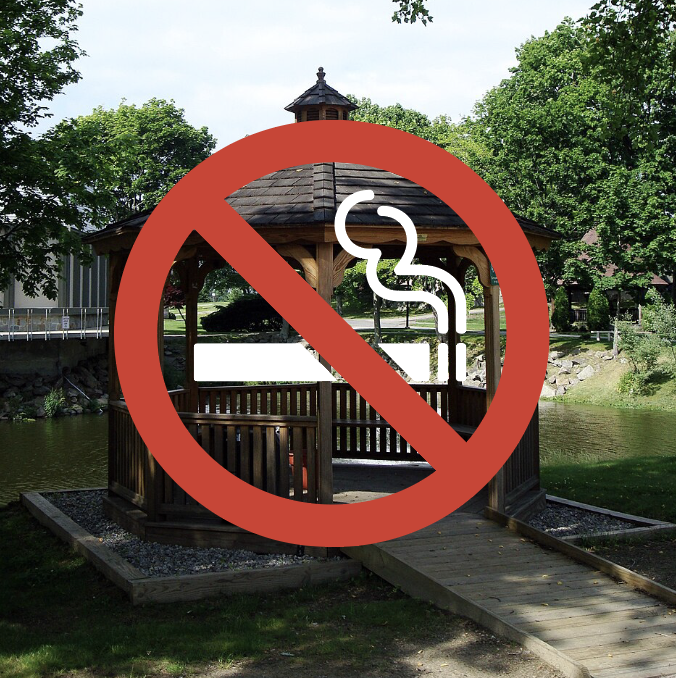
In 2023, Roger Williams University was given a $20,000 grant from the Truth Initiative to transition the campus to become smoke free. 2023 was met with conversations about removing the gazebos around campus which came with push back from students, faculty, and staff.
At Student Senate on March 23, Director of Health Promotion and Wellness Education, Cristelle Garnier, and Assistant Vice President for Student Life & Title IX Coordinator Jen Stanley attended to communicate with student leaders about the progress of the Truth Initiative, hoping to implement a Smoke Free Roger Williams by July 2026.
Stanley said Truth is a national organization that creates awareness and supports K-12 and higher education schools in their efforts to tobacco and cape free communities. The $20,000 grant, spearheaded by Stanley and assisted by Vice President for Student Life, John King and Director of Health Services, Anne Mitchell, was awarded to the University from Feb. 2023 through June 2024, and was extended through Dec. 2024. Garnier said part of the requirements for the grant was to create a task force to assess issues within the community, educate and engage the campus community, show tobacco resources, and give policy recommendations.
Residence Halls at RWU went smoke free in the early 2000s after the Station Night Club Fire in Warwick, Rhode Island in 2003, Stanley said. Additionally, after the Public Health and Workplace Safety Act passed in 2005, all RWU buildings became smoke free and the gazebos were established as a designated smoking area.
Garnier emphasized the fact that the purpose of the grant is to educate people on other options, not to condemn their choices to smoke: “I just really wanted to be intentional about how we think, and to start to think about what our community would look like if we just transitioned to something a little bit different?”
The grant was extended from June 2024 through December 2024 because Garnier and Stanley believed there was more work to be done in the campus community.
In September 2024, themed educational posters began appearing on bathroom doors. “Some focus on financial wellness and how you could possibly spend your money in a better way, some focus on social wellness, like how that impacts your friend group,” said Garnier.
The team also created “Quit Kits” which are small kits that have goodies in them to help people who struggle with a nicotine addiction. Garnier said in the kits, there is a notebook to possibly track for someone to track the last time they had nicotine, minty gum or mints to help with the cravings, and small trinkets to help with fidgeting and distract someone from the nicotine craving. Quit kits are currently located in the Center for Student Development.
The smoke free initiative is meant to promote a healthy campus and environmental wellness, healthy habits and physical wellness, saving money and financial wellness, and improving social life and social wellness, said Garnier.
Garnier explained next steps of the program with an email communication to students, faculty, and staff to tell them about the new initiative, with the policy implementation tentatively beginning this July.
Holding each other accountable is another part of the policy implementation. Garnier described the policy implementation as, “the last beast” of the project because of the big questions associated with it including, what is enforcement going to look like; are students going to get in trouble; what are consequences if they did?
Garnier left the door open to continue to work with students and the Student Senate to come up with effective solutions to these questions.
Student Senate Treasurer, William Strack asked if faculty and staff have also been consulted and notified of the change in policy. According to Garnier, when discussions first began, the biggest concern was faculty and staff. Garnier said the larger concern is with staff who may not have as much flexibility in their smoke breaks as faculty do. Garnier met with Dining General Manager, James Gubata to discuss how the change would affect dining staff specifically.
Strack also asked what enforcement would look like and who would enforce the smoke free policy. Garnier said Public Safety would most likely have some amount of responsibility, but could not say for sure if there was going to be a monetary punishment for students such as a fine, or if there was an education or campus beautification requirement instead.
Education on vaping and tobacco was also on students’ minds as the question of if incoming students and juniors would see a module added to their Vector education courses. Stanley said the courses are customizable and it may be an option, but she also wants to be mindful of the amount of courses the university is asking students to complete as part of their orientation.
The gazebos which were at the center of discussion in 2023, have taken a back burner, said Garnier. There have been discussions on ways to repurpose the gazebos. Stanley said the gazebos were a part of task force’s recommendations, however, the current priority is education and to slow down the conversation on gazebos to focus on education and policy implementation.
Stanley acknowledged RWU’s complex relationship with gazebos saying, “If that is the feeling, as long as there are gazebos here, people are always going to feel like that’s a smoking gazebo, then maybe that’s not the best thing to have because it may make the efforts to move this process forward much more challenging.”
Ultimately, the decision on if to remove the gazebos will be made strategically. “If you make a quick decision and just say, get rid of them, that might not be the smartest decision,” Stanley said. Stanley called for student feedback as to how to repurpose the gazebos to help inform the final decision.
Both Garnier and Stanley said that change takes time, and that on average, in a public health setting, change can take about five years. They are committed to hearing student, faculty and staff feedback as to how to make the transition to a smoke free campus easier.
“Our goal is really to just encourage better decisions. It’s not for us to tell you exactly what to do with your life, but we do want you to be building good habits,” said Garnier.